The concept of the “corporate perimeter” is dead. Ten years ago, security meant putting a firewall around the office building. Today, that building is empty, and the workforce is everywhere.
In 2023, cyberattacks against commercial entities surged by 38%, with the average data breach cost climbing to a staggering $4.45 million [Reference: IBM Cost of a Data Breach Report 2023]. Simultaneously, Gartner reports that 82% of organizations intend to maintain hybrid or fully remote work models permanently.
The Challenge: Traditional security tools cannot see or protect an employee connecting to the Salesforce database from a coffee shop Wi-Fi in Denver, or a developer accessing AWS servers from a home network in Austin.
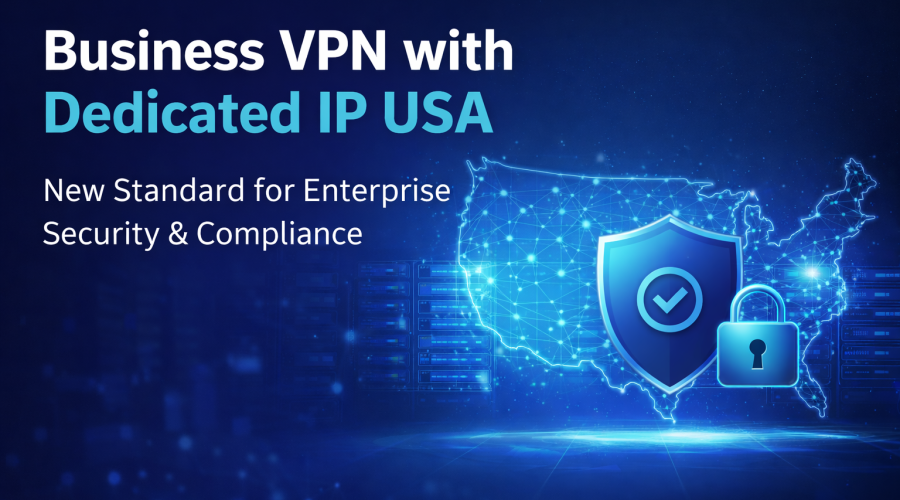
The Solution: A Business VPN with Dedicated IP USA infrastructure does not just encrypt data; it re-establishes the corporate perimeter in the cloud. It provides a static, verifiable identity for your organization, ensuring that even as your employees move physically, their digital footprint remains secure, constant, and compliant.
To understand the value, we must first understand the architecture.
Why not just use a standard, cheaper VPN? The answer lies in the “Noisy Neighbor” problem.
In a Shared IP environment (typical of consumer VPNs), your CEO might be sharing an IP address with a teenager downloading pirated movies or a botnet launching spam attacks.
Dedicated IPs eliminate these risks entirely. You own the reputation of your IP address.
This is the single strongest argument for Dedicated IPs. IT administrators can configure sensitive resources—such as the company Admin Panel, CRM, or Financial Dashboard—to only accept traffic from the specific Dedicated IP assigned to the company.
Attackers often scan for vulnerabilities by hiding inside the noise of high-traffic public IPs. A Dedicated IP makes traffic patterns clear.
Many B2B services (banking portals, payment gateways, legacy ERP systems) require a static IP for connection stability. Dynamic IPs that change every session often break these secure sessions, leading to timeouts and data entry errors.
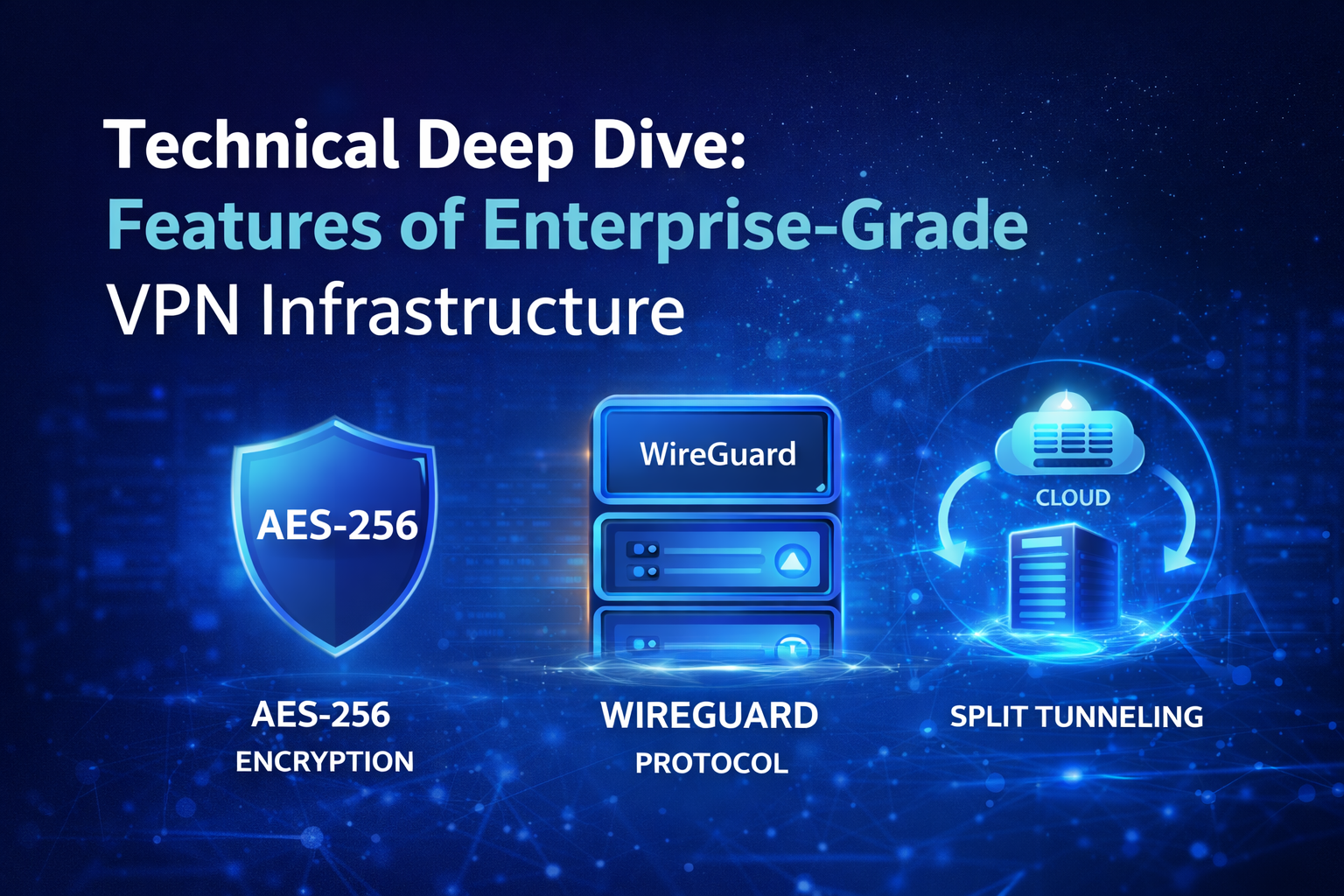
Enterprise VPNs must use AES-256 encryption. This standard is approved by the NSA for top-secret information. It would take a supercomputer longer than the age of the universe to crack a single key via brute force.
Speed determines adoption. If the VPN is slow, employees will turn it off.
Split Tunneling allows administrators to decide which traffic goes through the VPN and which goes directly to the internet.
A Business VPN is often a mandatory line item for regulatory audits.
Under the HIPAA Security Rule (45 CFR § 164.312), covered entities must implement technical safeguards for data in transit.
Financial institutions must track exactly who accesses data.
For defense contractors, the Cybersecurity Maturity Model Certification (CMMC) requires strict access control. Using a US-based Dedicated IP ensures that Controlled Unclassified Information (CUI) is accessed through compliant, domestic infrastructure.
Phase 1: The Audit (Week 1)
Phase 2: Configuration & Testing (Week 2-3)
Phase 3: Deployment & Training (Week 4)
Phase 4: Optimization (Ongoing)
| Feature | Shared IP VPN (Consumer) | Dedicated IP VPN (Business) |
| Identity | Anonymous / Hidden | Verifiable / Static |
| Access Control | None (Random IP) | Precise Whitelisting |
| Reputation | High Risk (Shared with unknowns) | Clean (Controlled by you) |
| Compliance | Often Non-Compliant | Audit-Ready (HIPAA/SOX) |
| Captcha Frequency | High | Near Zero |
| Cost | Low ($5-10/mo) | Medium ($20-50/mo) |
| Security Value | Privacy Only | Enterprise Security |
The ROI Calculation:
An Enterprise VPN may cost $10,000/year for a mid-sized firm. The average cost of a ransomware attack is $4.45 million. The VPN pays for itself if it prevents just one minor breach over a 400-year period.
Modern cybersecurity is moving toward Zero Trust Network Access (ZTNA). Does this make VPNs obsolete? No, it makes them part of a larger ecosystem.
A Business VPN with a Dedicated IP serves as the “secure gateway” into the Zero Trust architecture.
Integrating your VPN with Single Sign-On (SSO) tools like Okta or Azure AD adds another layer: even with the correct IP, the user must pass Multi-Factor Authentication (MFA).
Myth 1: “We use the cloud, so we don’t need a VPN.”
Reality: Cloud accounts are the most targeted. Without a VPN, anyone with a stolen password can log into your Cloud ERP from Russia or North Korea. With a Dedicated IP VPN, you can block all logins that don’t come from your specific VPN IP.
Myth 2: “VPNs destroy internet speed.”
Reality: This was true in 2010. Today, with 10Gbps servers and the WireGuard protocol, the overhead is negligible (often <5% reduction). Speed issues are usually due to the user’s home Wi-Fi, not the VPN.
Myth 3: “A dedicated IP compromises privacy because it’s linked to us.”
Reality: In a business context, anonymity is a liability. You want accountability. You want to know exactly which employee accessed a file. Privacy is for personal browsing; accountability is for enterprise security.
Q: Can we run a Business VPN on employee personal phones (BYOD)?
A: Yes. Enterprise VPN apps are available for iOS and Android. Using split-tunneling, you can configure the VPN to only encrypt work-related app traffic (e.g., Outlook, Salesforce) while leaving personal traffic (e.g., Instagram) untouched, protecting employee privacy while securing company data.
Q: How long does it take to deploy?
A: Cloud-based business VPNs can be deployed in days. Since there is no hardware to install, it involves purchasing licenses, provisioning the Dedicated IP (usually 24-48 hours), and distributing the software credentials.
Q: Is a US Dedicated IP safe if we have employees in Europe?
A: Yes, but latency may be a factor. If you have a large team in Europe, you should purchase a Dedicated IP located in a European data center (e.g., Frankfurt or London) for them. Best practice is to have regional gateways to ensure speed, while maintaining central policy control.
Q: What happens if the VPN server goes down?
A: Enterprise providers offer 99.9% uptime SLAs. However, for critical infrastructure, businesses often purchase two Dedicated IPs (Primary and Failover) to ensure redundancy.
The decentralized workforce is not a temporary trend; it is the new standard. In this landscape, relying on consumer-grade security tools or hoping that strong passwords are “enough” is a strategy for failure.
A Business VPN with Dedicated IP USA offers a unique convergence of benefits: it satisfies the compliance officer, empowers the IT administrator with control, and protects the business owner from catastrophic data loss.
Your Next Steps:
The cost of protection is a fraction of the cost of recovery. Secure your network identity today.
Disclaimer: This article provides general information about business VPN solutions and security best practices. It does not constitute legal advice. Consult with qualified IT security professionals and legal advisors to ensure your specific implementation meets all applicable regulations.