
Every 39 seconds, a cyberattack targets a small business. In the UK alone, 32 per cent of businesses experienced a cybersecurity breach in the last year, with costs averaging £4,200 per incident, according to the UK Government Cyber Security Breaches Survey.
Yet, here’s the shocking reality. Most small business owners still believe cybersecurity is too expensive or only necessary for large corporations. This misconception leaves critical company data, client information, and financial records exposed to increasingly sophisticated threat actors.
A VPN for small businesses in the UK is no longer just another IT expense. It is the first line of defence against data breaches, corporate espionage, and compliance violations. Whether you are managing a five-person startup in Manchester or a 50-employee operation in London, secure connectivity is no longer optional in 2026.
This comprehensive guide explains everything you need to know about implementing a VPN for small businesses in the UK, including real-world deployment strategies, cost breakdowns, regulatory compliance requirements, and expert security insights.
A business VPN creates an encrypted tunnel between employee devices and company network resources. Unlike consumer VPNs designed for streaming or privacy browsing, a VPN for small businesses in the UK prioritises data integrity, access control, and regulatory compliance.
A business VPN establishes a secure, encrypted connection using protocols such as OpenVPN, IKEv2 IPsec, or WireGuard. These protocols authenticate users, encrypt data packets, and route traffic through dedicated servers designed for corporate use.
This distinction is critical. When an accountant in Birmingham accesses sensitive financial records remotely, a consumer VPN offers basic encryption. A VPN for small businesses in the UK provides access controls, audit trails, and compliance documentation required by UK regulators.
Ransomware attacks increased by 87 per cent in the UK between 2023 and 2025, according to the National Cyber Security Centre. Small businesses account for 43 per cent of targets because attackers view them as data-rich but poorly defended.
A VPN for small businesses in the UK directly reduces this exposure by encrypting traffic and controlling access points.
72 per cent of UK businesses now support hybrid working models. Each unsecured home network increases the attack surface without a VPN for small businesses in the UK.
Employees accessing CRM systems from cafes, hotels, or airports transmit data over unsecured networks without VPN protection.
Hackers often breach small suppliers to infiltrate larger organisations, putting client relationships at risk.
The Information Commissioner’s Office continues strict enforcement of GDPR security requirements.
A Nottingham-based marketing agency with 12 employees lost all client data after an employee clicked a phishing link on airport Wi Fi. Without a VPN for small businesses in the UK, attackers intercepted credentials and deployed ransomware.
Total losses exceeded £54,000.
A £150 monthly VPN solution would have prevented the incident.
Not all VPNs meet business security requirements. A reliable VPN for small businesses in the UK must include the following.
AES 256 encryption is essential and is the same standard used to protect UK government classified information.
Providers should minimise or eliminate data retention while complying with UK legal frameworks.
Licences must support laptops, smartphones, tablets, and servers across Windows, macOS, iOS, Android, and Linux.
Dashboards should provide visibility into active users, permissions, and security events.
Allows business traffic through the VPN while routing general browsing normally for optimal speed.
Automatically blocks internet traffic if the VPN disconnects to prevent data leaks.
Low-latency performance requires physical servers in London, Manchester, or Edinburgh.
Critical for banking systems and internal applications that block shared IP traffic.
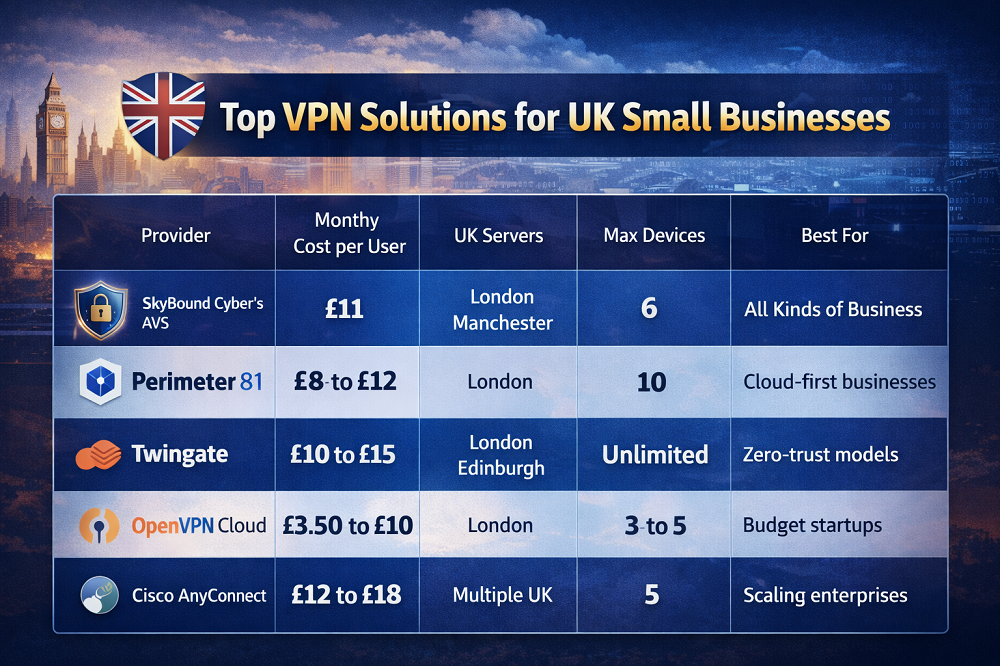
| Provider | Monthly Cost per User | UK Servers | Max Devices | Best For |
| SkyBound Cyber’s AVS | £11 | London Manchester | 6 | All Kinds of Business |
| Perimeter 81 | £8 to £12 | London | 10 | Cloud-first businesses |
| Twingate | £10 to £15 | London Edinburgh | Unlimited | Zero-trust models |
| OpenVPN Cloud | £3.50 to £10 | London | 3 to 5 | Budget startups |
| Cisco AnyConnect | £12 to £18 | Multiple UK | 5 | Scaling enterprises |
When selecting a VPN for small businesses in the UK, prioritise support availability, compliance features, and scalability.
UK GDPR mandates appropriate technical measures, including encryption and secure transmission channels. A VPN for small businesses in the UK directly supports these requirements.
The Information Commissioner’s Office advises securing data transmissions when accessed remotely. Business VPNs fulfil this obligation.
Myth 1: “VPNs Slow Down Internet Speed”
Fact: Modern protocols like WireGuard reduce speed by only 5-15%. For business apps, this is imperceptible.
Myth 2: “Only Tech Companies Need VPNs”
Fact: A Sheffield-based plumbing company storing customer addresses faces identical risks to a software startup. Data is data.
Myth 3: “VPNs Are Too Complex”
Fact: Modern business VPNs offer one-click installation. If you can join a Wi-Fi network, you can use a business VPN.
Myth 4: “We Use HTTPS, So We Don’t Need VPNs”
Fact: HTTPS only protects the browser. A VPN encrypts all traffic, including background apps, email clients, and file transfers.
A well-configured VPN for small businesses in the UK is most effective when paired with basic cyber hygiene.
Cybersecurity is an ongoing process, not a one-time task. A VPN for small businesses in the UK forms the foundation of secure remote access, data protection, and regulatory compliance at a fraction of breach recovery costs.
The real question is not whether you can afford a VPN for small businesses in the UK, but whether you can afford the cost of a breach.
Ready to secure your business network?
Explore enterprise-grade security solutions tailored for the UK market and take the first step toward safer operations today.
Q-1. Can I use a consumer VPN for my business?
Ans: Consumer VPNs lack centralised management, user controls, compliance logging, and audit trails. They are unsuitable for handling sensitive business data or meeting UK regulatory requirements effectively.
Q-2. Does a VPN protect data on public Wi Fi?
Ans: Yes. A VPN for small businesses in the UK encrypts all internet traffic, preventing hackers on public Wi Fi networks from intercepting credentials, emails, file transfers, or confidential business communications.
Q-3. Will cloud apps still work properly?
Ans: Yes. Most cloud applications like Office 365, Google Workspace, and Salesforce work seamlessly with business VPNs, with minimal latency impact and no disruption to daily workflows.
Q-4. What happens if the VPN disconnects?
Ans: If the VPN disconnects, a built-in kill switch immediately blocks internet access, preventing unencrypted data transmission and ensuring sensitive business information is never exposed accidentally.