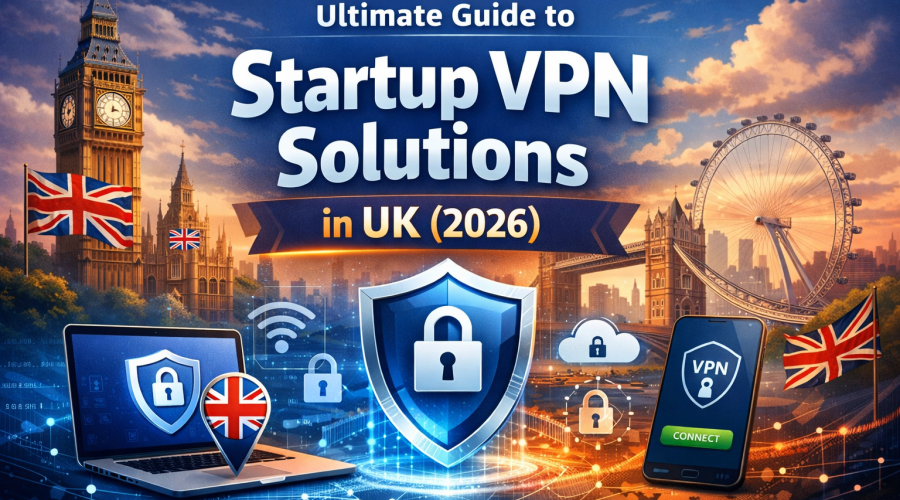
VPN Security for UK Startups: The Essential Guide to Protecting Your Business
Comprehensive guide to implementing enterprise-grade VPN security infrastructure for UK startups. Learn how to protect corporate data, enable secure remote work, achieve GDPR compliance, and scale your cybersecurity from 5 to 100+ employees.
95% of startups prioritise product development over cybersecurity. This makes perfect sense – you’re racing to achieve product-market fit, close your next funding round, and scale from 5 to 50 employees. Security feels like a “later” problem.
Until it becomes a right-now disaster.
The Harsh Reality
60% of small businesses that suffer a cyberattack close within 6 months (Source: UK Federation of Small Businesses). For startups operating on tight runways with fragile investor confidence, a single data breach can mean game over.
Yet here’s the opportunity hidden in this threat: implementing proper security infrastructure early becomes a competitive advantage. Enterprise clients demand security certifications. GDPR compliance isn’t optional. Remote hiring requires secure access controls.
This comprehensive guide addresses the specific cybersecurity needs of UK startups, from two-person operations working from co-working spaces in Shoreditch to 50-employee scale-ups managing distributed teams across Europe and the US. You’ll discover how to implement enterprise-grade VPN security on startup budgets, protect corporate data without slowing development velocity, and enable secure remote work that actually works.
Let’s transform security from a checkbox exercise into a strategic asset.
Why Startups Face Unique Security Challenges
The Attack Surface of Modern Startups
Traditional businesses operated from fixed offices with controlled network perimeters. Your startup likely operates across:
- Co-working spaces with shared Wi-Fi (London, Manchester, Bristol tech hubs)
- Home offices on residential ISP connections
- Coffee shops where engineers debug production issues
- International locations as you hire remote talent
- Client offices during sales meetings and implementations
Each environment represents a potential vulnerability. Unlike enterprises with dedicated IT teams, your CTO is also writing code, your founder is closing sales, and nobody has time to manage complex security hardware.
Specific Startup Vulnerabilities
-
Rapid Team Growth
You hire 5 people in a month. Each needs immediate access to AWS/Google Cloud, GitHub, Stripe, and Salesforce. Without systematic access controls, you’re granting admin credentials to everyone—a compliance nightmare waiting to happen.
-
Contractor & Advisor Access
Your fractional CFO needs QuickBooks access. Your marketing consultant requires HubSpot. How do you grant appropriate access without creating permanent security holes?
-
Investor Due Diligence
Series A investors conduct technical due diligence examining your InfoSec policies. Companies with documented security controls raise funding 23% faster (TechNation UK Startup Survey 2024). A Business VPN provides instant credibility.
-
Enterprise Client Questionnaires
Landing that first major corporate client requires answering detailed security questionnaires. A VPN helps you tick these critical boxes:
- Data encryption in transit
- Multi-factor authentication
- Access logging and monitoring
- GDPR compliance measures
Essential VPN Features for Growing Companies
Core Requirements for Startup VPNs
-
Zero-Trust Architecture
Traditional VPNs operate on “trust but verify.” Modern solutions like AVS VPN operate on Zero-Trust: verify continuously. This means device health checks before connection and session-based permissions rather than permanent access.
-
Scalable Licensing Models
You’re 7 people today, 40 by year-end. Avoid VPNs with rigid contracts. Look for providers offering monthly per-user billing and instant seat additions.
-
Cloud-Native Design
If your infrastructure lives in AWS, Google Cloud, or Azure, your VPN must integrate natively. Look for direct private connectivity to cloud VPCs and automatic security group updates.
-
Granular Access Controls
Not everyone needs access to everything. Your VPN must support role-based access control (RBAC):
- Engineers: Production AWS, GitHub
- Sales: CRM, Demo environments (NOT production)
- Contractors: Project-specific resources only
Advanced Features Worth Paying For
1. Split Tunneling Intelligence
Route company traffic through the VPN while sending general browsing (Spotify, YouTube) directly to the internet. This reduces latency and preserves bandwidth for business tasks.
2. Multi-Region Server Selection
Your London-based team works with US clients. Choosing New York VPN servers reduces latency to US-based SaaS apps and enables access to region-locked services.
Secure Work From Home Setup Guide
The Complete WFH Security Stack
All internet traffic from home devices routes through an encrypted tunnel to company infrastructure.
Real-time malware scanning and ransomware protection on all devices.
Require MFA for VPN connections and cloud apps.
Step-by-Step WFH VPN Deployment
Pre-Deployment (IT/Founder)
-
Inventory
List all employees and systems requiring secure access.
-
Select Provider
Choose a solution like Skybound Cyber’s AVS VPN that offers Dedicated IPs.
-
Testing
Deploy to technical leads first to measure performance.
Deployment (All Employees)
-
Installation
Send secure links for macOS/Windows/Mobile apps.
-
Verification
Confirm successful connections to critical tools.
-
Optimisation
Fine-tune server selection for speed.
Home Network Security Checklist for Employees
- Change default router admin passwords
- Enable WPA3 (or WPA2) encryption on home Wi-Fi
- Install OS updates within 48 hours of release
- Never leave unlocked devices unattended in shared spaces
Corporate Data Protection Strategies
Understanding Your Data Categories
Critical Business Data
Customer PII (GDPR), Financial records, IP/Source Code
Internal Operations
Project management, internal communications
Public Data
Marketing content, public documentation
VPN Role in Data Protection Lifecycle
1. Data in Transit Protection
Without a VPN, data crosses ISP infrastructure and public Wi-Fi—potential interception points. With a VPN, AES-256 encryption renders intercepted data useless to attackers.
2. Audit Trail Creation
Compliance requires documenting who accessed what data. AVS VPN automatically logs:
- User authentication times
- Resources accessed
- Source IP addresses
This satisfies GDPR Article 30 record-keeping requirements.
Bypassing Geo-Restrictions for Global Teams
The Remote Talent Opportunity
UK startups increasingly hire globally to access specialised skills or reduce costs. However, many business tools restrict access by geography.
Common Scenarios
US-Based SaaS Tools
Your developer in Poland needs access to a US-only payment gateway.
Solution: Connect via a US VPN server.
UK Banking
Your French contractor needs to process expenses in Revolut Business.
Solution: Connect via a London VPN server.
Content Testing
Your marketing team needs to view competitors’ ads as they appear in Germany.
Solution: Connect via a Frankfurt VPN server.
Best Practice
Create a written policy stating that VPN geo-location features are solely for business operations, not for bypassing licensing on personal streaming services.
Budget-Friendly VPN Solutions for Startups
Total Cost of Ownership Analysis
For a typical 10-person startup, the investment is minimal compared to the risk.
VPN Solution Tiers
| Tier | Best For | Pros | Cons |
|---|---|---|---|
| Tier 1: Open Source (OpenVPN Cloud) | Bootstrap (Founder + 2) | Free tier available | Requires technical skill to manage; no support |
| Tier 2: Agile Business VPN (Skybound Cyber / AVS) | Growing Startups (5-100) | Dedicated IPs, UK Support, Fast Deployment, Affordable | Focused on business use, not streaming unlocking |
| Tier 3: Legacy Enterprise | Scale-Ups (100+) | Extreme customisation | Expensive, complex setup, requires dedicated IT staff |
Why Skybound Cyber is the Startup Choice
Unlike generic “Big Box” VPNs, Skybound Cyber offers Dedicated IPs (essential for whitelisting) and Direct UK Support. You aren’t just a ticket number; you get a security partner.
Scaling Your VPN Infrastructure
Challenge: Outgrowing free tiers
Solution: Graduate to AVS VPN Team Plans with centralised management.
Challenge: Departments need different access levels
Solution: Implement Role-Based Access Control (RBAC).
Challenge: Compliance requirements intensify
Solution: Deploy dedicated gateways and conduct ISO 27001 readiness audits.
Integration with Startup Tech Stack
1. Cloud Infrastructure (AWS/Azure)
Use your VPN’s “Private Access” features to tunnel directly into your Virtual Private Cloud (VPC). This means you don’t need to leave your database ports open to the public internet.
2. Identity & Access (Google/Microsoft)
Integrate AVS VPN with Google Workspace or Microsoft 365 (SSO).
Benefit: Employees use their existing work email to log in.
Automation: When you delete a user in Google Workspace, their VPN access is automatically revoked.
3. Mobile Device Management (MDM)
Push the VPN configuration profile to all company laptops and phones using tools like Jamf or Intune. This ensures 100% adoption without user error.
Common Mistakes to Avoid
-
Treating VPN as a “Silver Bullet”
It’s the foundation, not the whole house. You still need antivirus and strong passwords.
-
Granting Excessive Permissions
Don’t give the marketing intern access to the production database. Use “Least Privilege” access.
-
Neglecting Mobile
Startups live on mobile. Ensure your VPN works seamlessly on iOS and Android.
-
Ignoring Offboarding
The biggest risk is a disgruntled ex-employee with active credentials. Automate your offboarding.
-
Choosing on Price Alone
Saving £2/month isn’t worth it if the support team takes 3 days to reply during a crisis.
Expert Implementation Roadmap: The 30-Day Plan
Week 1: Discovery
Audit your current tools and list who needs access to what. Sign up for a Skybound Cyber trial.
Week 2: Setup
Configure your Dedicated IP and integrate with your email provider (SSO).
Week 3: Pilot
Deploy to your Engineering team first. Test latency and workflows.
Week 4: Rollout
Deploy to the whole company. Host a 15-minute “Security Training” session to explain why this matters.
Frequently Asked Questions
Yes. Small teams handle sensitive data (IP, financials) with minimal protection. A small monthly investment prevents catastrophic breach costs later.
Modern protocols like WireGuard (used by AVS VPN) add only 10-20ms latency—imperceptible for work. Split tunneling further optimises speed by routing video calls outside the tunnel.
Yes, this is a legitimate business case. A VPN with UK servers allows global talent to access UK-specific banking or admin dashboards securely.
Frame it as an asset, not a cost. It reduces breach risk by 78%, enables enterprise sales, and demonstrates maturity to investors during due diligence.
Conclusion: Building Security Into Your Startup DNA
Most startups treat security as compliance theatre—implementing tools to satisfy investor checklists without understanding their strategic value. This is a missed opportunity.
Proper security infrastructure, with a Business VPN as the foundational layer, enables you to:
- Hire world-class talent from anywhere
- Close enterprise deals faster
- Protect your runway from reputation damage
- Demonstrate investor-ready maturity
- Achieve regulatory compliance (GDPR, Cyber Essentials, ISO 27001)
Don’t wait for a breach to take action.