Since 2021, growing organizations across industries, from 10-person startups to 200-employee manufacturers, SaaS teams, creative agencies, and distributed remote companies, have been asking the same question again and again:
“Do we really need to replace our VPN with Zero Trust, or is this just vendors pushing expensive solutions we don’t actually need?”
The truth is that the debate of Zero Trust vs. VPN is complicated, but not in the exaggerated way most tech blogs describe it. Many organizations in 2025 sit in an uncomfortable middle zone. Their VPN feels outdated and risky. Zero Trust looks modern and appealing. But completely rebuilding access systems feels overwhelming, costly, and disruptive to ongoing operations.
The challenge isn’t choosing a trendy security philosophy. It’s understanding what each model actually does, what constraints a business faces, and what path reduces real-world risk without unnecessary chaos.
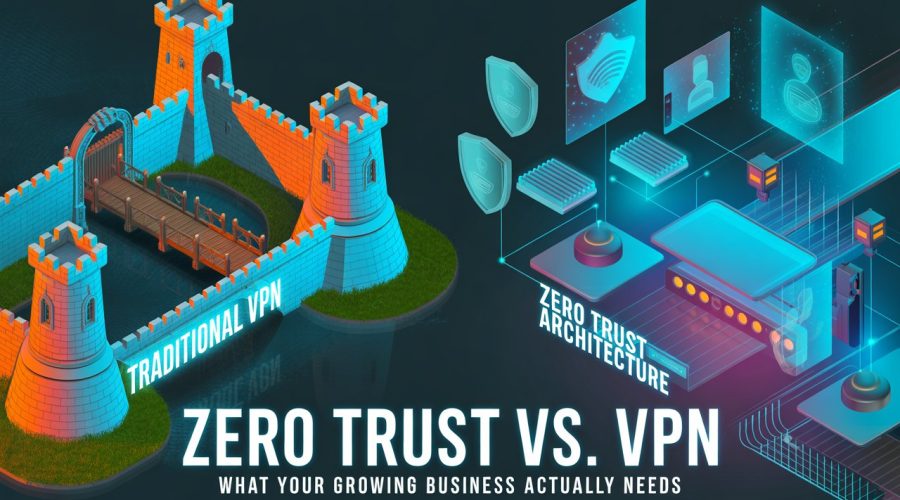
A VPN extends the internal network to a remote device. Once a user authenticates, their laptop behaves as if it’s physically inside the office. The model is simple:
Trust the user after one successful verification.
Because of that design, once an attacker steals credentials, they can often explore the entire network without additional checkpoints.
Common VPN tools include Cisco AnyConnect, OpenVPN, WireGuard, Fortinet, and others.
Zero Trust reverses the assumption that a user or device should be inherently trusted after initial login.
Every access request gets validated, even the ten consecutive requests made by the same user to the same internal resource.
Zero Trust asks:
What makes the Zero Trust vs. VPN comparison interesting is that Zero Trust is not a single tool, it’s an ecosystem. Zero Trust stacks commonly include Microsoft Entra ID + Intune, Cloudflare Access, Okta, Zscaler, or Twingate.
And yes, it often costs more.
But many companies are surprised to learn that a good hybrid model is often more reasonable than replacing everything at once.
Despite constant marketing pressure, there are many scenarios where a VPN is still the right tool for the job, at least for now.
Many manufacturers, logistics providers, finance firms, and healthcare operations run mission-critical software built in the 2000s or early 2010s. These applications often only support internal IPs, old protocols, or outdated network models.
Moving such systems to Zero Trust may require:
A modern WireGuard VPN with MFA and strong endpoint detection can reduce 90–95% of the risk without needing a full system overhaul.
Law firms, accounting partners, external consultants, and freelance designers often refuse MDM controls on their personal laptops. Zero Trust requires device posture checks, but unmanaged devices cannot meet compliance.
A VPN with strict MFA remains the more realistic access method.
If 70–80% of employees work from a physical office and remote access is occasional, Zero Trust may not provide enough additional value to justify immediate migration.
Some companies have already purchased multi-year licensing for Cisco, Fortinet, Palo Alto, or SonicWall. Extending these solutions for another 24–36 months can be cost-effective.
In these cases, the Zero Trust vs. VPN question is more about timing than necessity.
On the other hand, certain signals strongly suggest that organizations must shift away from VPN-centric security.
VPNs were designed for occasional remote work, not for being the primary access method for half the company.
If core infrastructure runs on:
…then a cloud-first Zero Trust model is more appropriate than tunneling everything through a legacy VPN.
VPN credentials are among the easiest things for attackers to steal.
Under Zero Trust, compromised credentials don’t automatically imply compromised access.
GDPR, CCPA, HIPAA, PCI-DSS, and government frameworks increasingly demand:
Zero Trust provides these audit trails. VPN does not.
Frequent RDP/SSH access to cloud servers is vastly more secure under Zero Trust, which validates every session and logs every action.
VC due diligence and cyber insurance assessments increasingly look for Zero Trust adoption as a maturity indicator.
If at least two of these apply, the Zero Trust vs. VPN decision heavily favors the Zero Trust direction.
In 2025–2026, the real-world winning model isn’t choosing Zero Trust vs. VPN, it’s combining them intelligently.
This becomes the authentication backbone, enforcing MFA at identity level.
Cost: £6–12 per user per month
Only secure, encrypted, patched devices gain access.
Cost: £8–15 per user per month
This replaces traditional “VPN for everything” with app-level secure access.
Cost: £12–30 per user per month
Only 5%–10% of users typically need this.
Cost: £5–8 per user per month
A critical layer to catch intrusions early.
Total security cost for a 50-person company:
£35–55 per user per month
Compared to a potential ransomware payout, extremely cheap.
This hybrid design ends the Zero Trust vs. VPN binary debate entirely by using each tool where it fits best.

1. Is more than 30% of your team remote?
If yes → Lean toward Zero Trust.
2. Are you 100% cloud/SaaS?
If yes → Zero Trust is ideal.
3. Do you have legacy systems stuck on internal networks?
If yes → You will need a limited VPN.
4. Is cyber insurance pushing you toward modern controls?
If yes → Zero Trust is becoming mandatory.
5. Are you raising capital in the next 24 months?
If yes → Investors will expect Zero Trust maturity.
6. Can your budget handle £40+ per user per month for security?
If no → Start with strong VPN + MFA.
This structured approach helps businesses evaluate the Zero Trust vs. VPN question with clarity.
This roadmap avoids rushed decisions and supports smooth, manageable upgrades.
There is no single “correct” winner in the Zero Trust vs. VPN debate. For most organizations, the right answer is not one or the other, but a security model tailored to actual needs, risks, and constraints.
Sometimes VPN is perfectly sufficient.
Sometimes Zero Trust is essential.
Often, a hybrid approach is the practical reality.
The organizations that build strong security in 2025–2026 aren’t the ones following vendor hype. They’re the ones who clearly understand:
That clarity, not the choice between Zero Trust vs. VPN, is what creates genuinely secure, resilient, future-ready businesses.